The Underwater Forest Is Coming Back — And It's Bringing the Whole Neighborhood With It
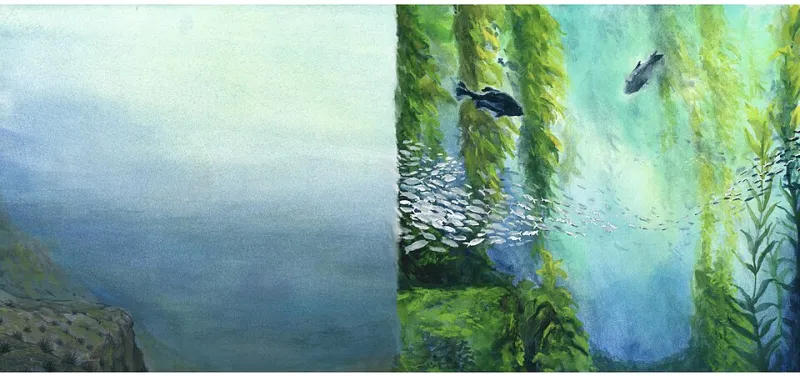
Photo: Claudia Schioppa/CMCC Foundation, CC BY-SA 4.0, via Wikimedia Commons
Imagine diving into water so thick with towering kelp that the light filters down in golden columns, the way it does through a cathedral window. Schools of rockfish hang suspended between the fronds. A harbor seal corkscrews past you and disappears into the green. A spiny lobster picks its way across the reef below.
For anyone who dove the California coast in the 1980s, that image is a memory. For a lot of younger divers, it sounds like fiction.
But something is changing. Slowly, improbably, in patches along the coastline from Mendocino County down through the Monterey Peninsula, the kelp is coming back. And the story of how it's happening — and who's making it happen — is one of the most quietly extraordinary conservation tales unfolding in America right now.
What Happened to the Forests
To understand the restoration movement, you have to understand how badly things fell apart.
Giant kelp — Macrocystis pyrifera — is one of the fastest-growing organisms on earth, capable of adding a foot of height per day under ideal conditions. For thousands of years it formed vast underwater forests along the Pacific coast, creating some of the most biodiverse marine habitat on the planet. Hundreds of species depend on kelp forests at some stage of their lives. The forests also absorb carbon, buffer coastlines from wave energy, and support commercial fisheries worth hundreds of millions of dollars annually.
Then came a cascade of pressures. The 2014-2016 marine heat wave, fueled by climate change, sent water temperatures soaring. Warm water is bad for kelp. Around the same time, a sea star wasting disease wiped out sunflower sea stars — the primary predator of purple sea urchins — up and down the coast. With nothing eating them, urchin populations exploded. And urchins eat kelp. By 2019, surveys off the Northern California coast found that more than 90 percent of the kelp canopy had disappeared in some areas, replaced by what marine ecologists bleakly call "urchin barrens" — flat, scoured seafloor carpeted in spiny purple bodies and almost nothing else.
The fishing communities that had built their livelihoods around kelp-associated species — red abalone, red urchin, various rockfish — felt it immediately. Dive operations shuttered. Processors laid off workers. Entire coastal economies went sideways.
The Urchin Problem and the People Who Decided to Fix It
Here's the weird thing about urchin barrens: the urchins themselves are starving. Purple urchins in a barren have eaten everything available and are now just waiting — their gonads shrunken, their bodies essentially hollow. They're not commercially valuable in that state. But they're still out there, still preventing kelp from reestablishing, still a problem.
A handful of people started asking an obvious question: what if we just removed them?
In Mendocino County, a nonprofit called the Reef Check Foundation and a local group called the Greater Farallones Association began organizing volunteer diving events to manually remove purple urchins from targeted reef sections. The work is exactly as unglamorous as it sounds — divers descending repeatedly with hammers and mesh bags, smashing urchins by the thousands, then hauling the debris to the surface. It's exhausting. It's time-consuming. And in the areas where it's been done consistently, kelp has returned with startling speed.
Further south, the Nature Conservancy partnered with commercial urchin divers to develop a different approach: removing the starving urchins and placing them in land-based aquaculture tanks, where they're fattened up on kelp scraps and eventually sold to sushi restaurants as premium uni. It's simultaneously a restoration technique and a new revenue stream for divers who've watched their traditional fisheries collapse.
"We turned the problem into the product," said one Sonoma County diver involved in the program. "Those urchins were worthless in the water. Now they're paying my mortgage."
What's Coming Back — and What It Means
The ecological response to successful kelp restoration has surprised even optimistic researchers.
In areas where urchin removal has allowed kelp to reestablish, the recovery of associated species has been faster than many models predicted. Juvenile rockfish — several species of which are commercially important and have been under intense fishing pressure for decades — have returned to restored patches in significant numbers. Lingcod, cabezon, and sheephead are showing up. In some locations, researchers have documented the return of red abalone, a species whose recreational fishery has been closed since 2018 due to collapse.
The food web effects ripple upward. More fish means more food for marine mammals. Harbor seals and California sea lions have been documented hunting in restored kelp stands. There are anecdotal reports — not yet confirmed by formal surveys — of increased humpback whale activity near restoration sites, potentially tracking prey concentrations associated with recovering fish populations.
Above the water line, the economic signals are also starting to turn. Dive tourism operators in areas near active restoration projects report growing interest from recreational divers eager to see the recovery firsthand. A few forward-thinking fishing cooperatives have begun marketing their catch as "kelp forest recovered," betting that consumers will pay a premium for seafood tied to a restoration story.
Tribal Nations at the Center of It All
Any honest account of kelp forest restoration on the Pacific coast has to center the Indigenous communities that have been managing these ecosystems — or watching them be mismanaged — for generations.
Several tribes along the Northern California coast have deep cultural and subsistence relationships with species that depend on kelp forests, particularly abalone, which holds significant ceremonial importance. As the forests collapsed, those relationships were severed in painful ways.
Now, tribal nations including the Kashia Pomo and various Northern California coastal groups are asserting a leading role in restoration planning. Some have established their own monitoring programs. Others are partnering with state agencies and universities to ensure that restoration priorities reflect Indigenous ecological knowledge alongside Western scientific frameworks.
"We've been watching this coast longer than anyone," one tribal environmental coordinator told a gathering of restoration practitioners last year. "We know what it looked like before. We know what it's supposed to be."
The Long Road Back
Nobody involved in kelp restoration is declaring victory. The forces that drove the collapse — warming oceans, disrupted predator-prey dynamics, chronic pollution — haven't gone away. Climate projections suggest the Pacific will continue to warm, and future heat events could undo years of painstaking restoration work in a single bad season.
But the people doing this work have a particular kind of stubbornness that seems native to coastal communities. They've seen what can be lost. They've also started to see what can come back.
On a restored reef off the Sonoma County coast, a volunteer diver recently surfaced after a monitoring dive and pulled off her mask. The kelp had come back to that section two years ago. She'd been diving it since it was a barren.
"It looks like the pictures from the seventies now," she said. "I didn't think I'd ever see that."
The forest is returning. And it's bringing the whole neighborhood with it.