Eyes on the Water: Meet the Volunteer Sleuths Revolutionizing Orca Research One Sighting at a Time
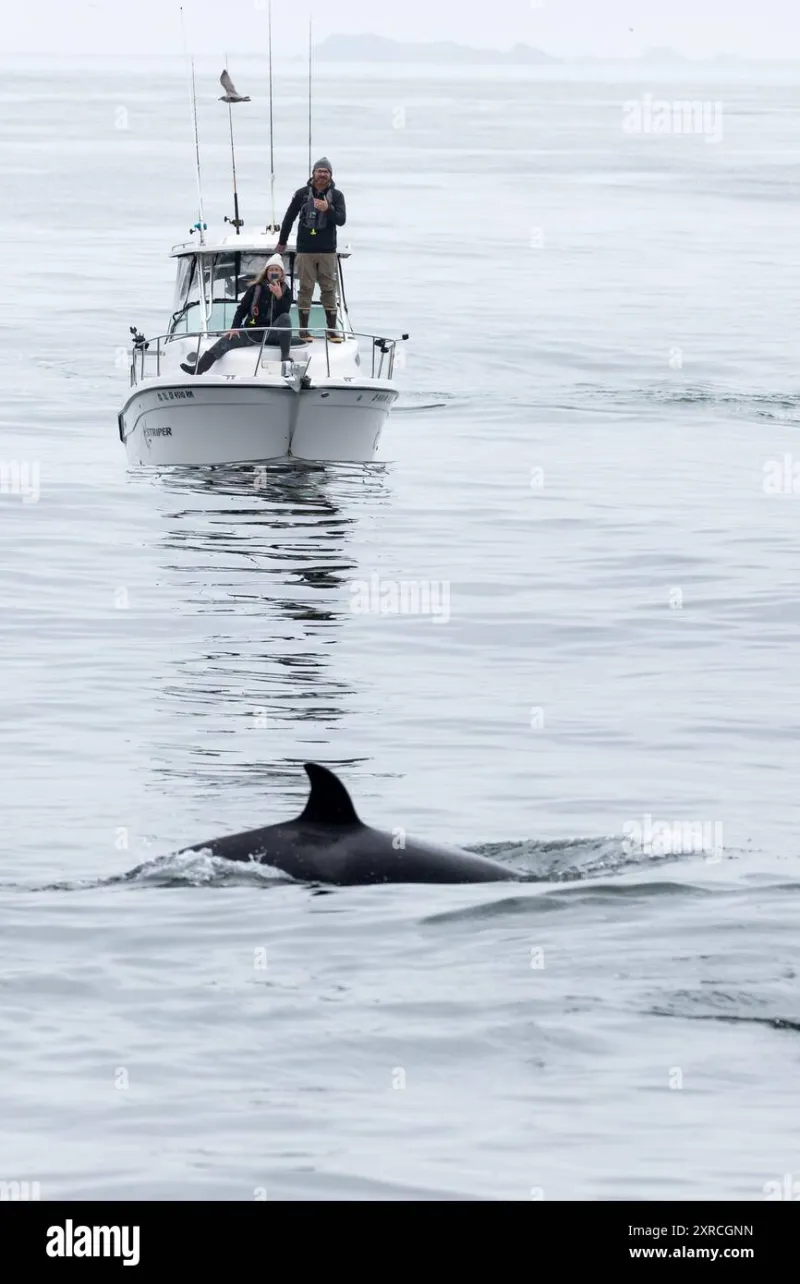
Photo: citizen scientist watching orca killer whale from small boat Pacific Northwest, via c8.alamy.com
On a foggy Tuesday morning in the San Juan Islands, a retired postal worker named Dave Kowalski is doing what he does almost every day — standing on the bow of his 22-foot aluminum skiff, binoculars pressed to his face, scanning the gray chop of Haro Strait. He's not fishing. He's not sightseeing. He's working, in his own way. His waterproof notebook is already half full of timestamps, GPS coordinates, and dorsal fin sketches. By noon, those notes will be uploaded to a shared database that researchers at three different universities actively monitor.
Dave isn't a marine biologist. He doesn't have a PhD. What he has is eleven years of near-daily observations, an almost supernatural ability to recognize individual orcas by the subtle curves of their saddle patches, and a commitment that frankly embarrasses a lot of grant-funded scientists who can only afford a few weeks on the water per year.
"The whales don't take summers off," he told us with a shrug. "So neither do I."
Dave is one node in a sprawling, informal network of citizen scientists stretching from the Salish Sea down through Oregon and into Northern California — people who have quietly become indispensable to orca conservation without ever appearing in a scientific journal as a lead author.
Why Professional Science Can't Do This Alone
Here's the uncomfortable truth that most marine researchers will admit off the record: traditional field science is expensive, slow, and riddled with gaps. Funding cycles mean research vessels sit docked for months at a time. Graduate students rotate in and out. Government agencies are perpetually underfunded. The result is a patchwork of data — rich in some seasons, nearly absent in others — that makes it genuinely hard to understand how orca populations are changing over time.
The Southern Resident killer whales, the iconic population that frequents the waters off Washington State and British Columbia, have been studied more intensively than almost any other cetacean group on earth. And yet scientists still have major blind spots: where exactly the whales go in winter, how often they're encountering prey shortages in real time, and how boat traffic patterns affect their behavior on an hour-by-hour basis.
That's where the volunteer network steps in. Because these folks are out there constantly — weekends, winters, early mornings — they're catching things that scheduled research cruises simply miss.
The Surprising Science Coming From the Crowd
Some of the most compelling recent discoveries about Pacific Northwest orcas have had citizen science fingerprints all over them.
A few years back, a kayaker near Port Townsend, Washington, captured video of a Southern Resident female behaving in a way that didn't fit any documented pattern — she appeared to be deliberately beaching herself on a shallow gravel bar, then righting herself and swimming away. The footage made its way to researchers who recognized it as a possible form of play behavior, or potentially a novel foraging attempt, that had never been recorded in this population. Without that one person paddling in the right place at the right time, the moment would have vanished.
Then there's the acoustic data. A loose coalition of volunteers up and down the coast has been deploying homemade hydrophones — underwater microphones built from off-the-shelf components — and uploading recordings to shared cloud servers. Researchers combing through that audio have identified call types that weren't in the existing catalog, raising intriguing questions about dialect variation and social learning in orca groups.
And perhaps most critically, citizen observers have been documenting the frequency of vessel disturbances with a granularity that no official monitoring program could replicate. Their logs have directly informed regulatory conversations about speed limits and no-go zones in critical feeding habitat.
How the Network Actually Works
There's no single organization running all of this. That's kind of the point. The network is genuinely grassroots — a constellation of local whale-watching clubs, independent Facebook groups, Discord servers, and regional nonprofits that have learned to share information across organizational lines.
Groups like Orca Network, based in the Pacific Northwest, serve as informal hubs, aggregating sighting reports and connecting volunteers with researchers who can make use of the data. The Whale Museum on San Juan Island has long cultivated relationships with regular observers. And apps like Happywhale have given individual contributors a way to submit photos that get automatically matched against known individual catalogs — turning a snapshot taken from a ferry into a data point that researchers can actually use.
What makes it work, insiders say, is trust built over years of showing up. Researchers who initially viewed citizen data skeptically have come around as they've seen how consistent and accurate certain contributors are. And volunteers who once felt like outsiders have found themselves invited onto research vessels, included in conference calls, and credited in published papers.
"It stopped being us versus them a long time ago," said one Seattle-area volunteer who asked not to be named. "Now it's just — we're all trying to figure out what's happening to these animals."
The Stakes Have Never Been Higher
This matters because the Southern Residents are in serious trouble. The population hovers around 70 individuals — a number that keeps marine biologists up at night. Chinook salmon, their primary prey, remain depleted across much of their range. Vessel noise interferes with their ability to echolocate and hunt. Toxic contaminants accumulate in their blubber at alarming concentrations.
In that context, every additional data point is precious. Every confirmed sighting, every behavioral note, every acoustic recording adds to a picture that scientists are desperately trying to complete before it's too late to act on.
The volunteers understand this. Many of them got into this work because they fell in love with these animals — watched a breach from a ferry deck and felt something shift inside them. Now they're driven by something closer to urgency.
What You Can Do
You don't need to live in the Pacific Northwest to plug into citizen orca science. Organizations like Happywhale accept sighting reports from both coasts. Orca Network maintains a phone hotline for Pacific Northwest sightings. And if you're planning a trip to the Salish Sea, consider scheduling a session with one of the established volunteer groups — many of them welcome newcomers who are willing to learn the protocols.
Bring patience. Bring waterproof gear. And if you're lucky enough to see a dorsal fin slice through the gray water off San Juan Island, take your photo, note your time and location, and submit it. That data belongs to the animals as much as it does to science.
Dave Kowalski would tell you the same thing. He's already back out on the water.