Killer Whales Are Smarter Than We Thought — And the Science Is Blowing Minds
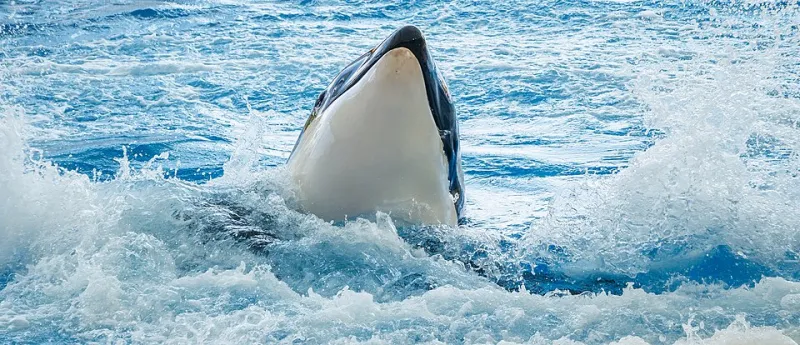
Photo: H. Zell, CC BY-SA 3.0, via Wikimedia Commons
There's a moment researchers describe — the kind that stops you cold — when an orca does something that has no business happening by accident. Maybe it's a mother demonstrating a beaching technique to her calf, repeating it slowly, deliberately, until the younger whale tries it on its own. Maybe it's a pod coordinating a wave-washing hunt with the kind of precision that takes human athletes years to develop. Whatever the moment, the message lands the same way every time: these animals are thinking.
Scientific teams studying wild orca populations along the Pacific Northwest coast have been collecting those moments for years. And the picture they're assembling is nothing short of extraordinary.
Teaching, Learning, and Passing It Down
One of the most striking findings to emerge from recent field research is just how intentional orca teaching behaviors appear to be. Unlike simple imitation — where a young animal picks up a skill by watching — researchers have documented scenarios where adult orcas actively modify their behavior when a juvenile is present, slowing movements, repeating sequences, even physically guiding calves through complex maneuvers.
This kind of scaffolded instruction is rare in the animal kingdom. Humans do it. Some great apes do it. And now, increasingly, the data suggest that orcas do it too.
Off the coast of Washington and British Columbia, Bigg's killer whales — also called transient orcas — have been observed coaching younger pod members in the fine art of hunting marine mammals. These aren't simple chase-and-catch scenarios. Bigg's orcas hunt seals, sea lions, and even gray whale calves using strategies that require coordination, timing, and role differentiation. Different pod members take on different jobs. And critically, those roles appear to be taught, not just stumbled upon.
Problem-Solving in Real Time
If teaching represents the long game of orca intelligence, problem-solving captures the immediate spark of it. Researchers have been cataloguing instances where wild orcas adapt their strategies on the fly in response to novel challenges — prey that behaves unexpectedly, environmental obstacles, or the presence of human vessels disrupting a hunt.
In one widely discussed case from the Pacific Northwest, a group of transient orcas was observed modifying their approach to a harbor seal that had taken refuge on a rocky outcropping. Rather than abandoning the hunt, the group circled, tested angles, and eventually coordinated a wave surge that dislodged the seal. The whole sequence unfolded over nearly 20 minutes — a timeline that suggests deliberation, not instinct.
This kind of flexible, situational thinking is what cognitive scientists call "executive function" — the ability to plan, inhibit impulse, and adjust behavior based on changing conditions. It's the stuff that, in humans, we associate with higher-order intelligence. In orcas, it appears to be woven into the fabric of daily survival.
Culture and Identity in the Water
Here's where things get genuinely fascinating: orca pods don't just share hunting techniques. They share culture.
The Southern Resident killer whales — the iconic, endangered population that ranges along the coasts of Washington, Oregon, and British Columbia — have distinct dialects. Specific call sequences are unique to individual pods, passed down across generations. These aren't random vocalizations. They're identity markers, social glue, and potentially carriers of encoded information about hunting grounds, family relationships, and environmental conditions.
When a Southern Resident pod loses a member, particularly a matriarch who carries decades of ecological knowledge, that loss reverberates through the group's survival capacity. It's not just grief in a poetic sense. It's a genuine information deficit. The elders know where the Chinook salmon run. They know the seasonal patterns. They know what worked last winter and what didn't. When they're gone, that knowledge doesn't automatically transfer.
This is why researchers argue that conservation strategies for orcas need to account for cultural continuity — not just population numbers.
What This Means for Conservation
The cognitive complexity of orcas poses a direct challenge to how we typically approach marine mammal protection. Standard conservation frameworks focus on habitat preservation, prey availability, and pollution reduction — all critical, all necessary. But if orcas are cognitively sophisticated enough to have culture, to teach, to problem-solve, then their wellbeing can't be reduced to a checklist of physical resources.
Stress matters. Social disruption matters. The constant acoustic interference from commercial shipping traffic in the Salish Sea isn't just a nuisance — for animals that rely on echolocation and complex vocalizations, it's a cognitive burden. Studies have shown that Southern Residents vocalize more loudly and more frequently when vessels are nearby, burning energy they can't afford to spare when their primary prey — Chinook salmon — is already in steep decline.
The argument gaining traction among marine biologists is that protecting orcas means protecting the conditions that allow their intelligence to function. Quiet waters. Abundant prey. Stable social groups. These aren't luxuries. For animals this cognitively complex, they're baseline requirements.
The View From the Shore
For those of us who've stood on a Washington bluff or leaned over the rail of a ferry in Puget Sound, watching a dorsal fin slice the surface — the research lands differently than it might in a journal abstract. It transforms the experience.
Knowing that the matriarch leading a pod might be navigating by memory, making decisions shaped by decades of accumulated knowledge, communicating in a dialect her grandcalves will one day teach to their own young — that changes what you're looking at. It's not just wildlife. It's a civilization, moving through water.
Organizations like the Center for Whale Research and Orca Network are doing essential work tracking Pacific Northwest populations and translating field data into conservation policy. Supporting them — financially, politically, or simply by staying informed — is one of the most direct ways outdoor enthusiasts can engage with what the science is revealing.
Because here's the thing: the orcas are passing down their knowledge. The question is whether we'll be smart enough to protect the world they're teaching each other to navigate.