Turn Off the Porch Light, Save a Turtle: The Quiet Movement to Darken America's Coastlines
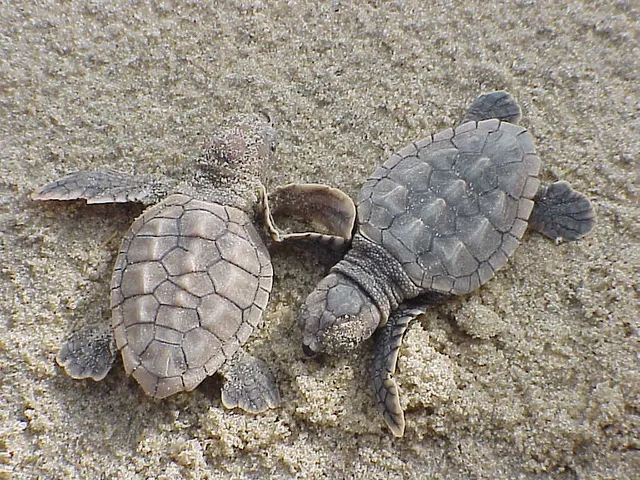
Photo: U. S. Fish and Wildlife Service - Northeast Region, Public domain, via Wikimedia Commons
There's a moment on Florida's Atlantic coast, usually around 10 p.m. in the middle of hatching season, when a volunteer named Dana Reyes does something that looks like a neighborhood dispute waiting to happen. She knocks on doors and asks strangers to turn off their lights.
Most of them do. Not because they've suddenly become die-hard environmentalists overnight, but because Reyes shows them the photo she keeps on her phone: a handful of baby loggerhead turtles, dead in the dune grass, drawn inland by the glow of a backyard floodlight instead of out to sea.
"The ocean used to be the brightest thing on the horizon," she told me. "Now we've made it the dark thing. And the turtles are reading the map backwards."
The Sky Is Part of the Ecosystem
We spend a lot of ink on this site talking about what's in the water — the salmon, the orcas, the kelp forests making their comeback. What we talk about far less is what's above it. But ask a marine ecologist and they'll tell you something that sounds almost poetic until you sit with it: the night sky functions like an ocean. Animals navigate it, migrate by it, and time their entire lives to its rhythms.
Sea turtle hatchlings are the famous case. They emerge from nests at night and steer toward the lighter seaward horizon — moonlight and starlight reflecting off open water. Coastal development has scrambled that cue so badly that in heavily lit areas, disorientation rates for hatchlings can approach near-total. The babies don't head for the ocean. They head for the highway.
It's not just turtles. Fledgling seabirds like Bonin petrels and shearwaters use starlight and moon glow for their first flights, and bright coastal towns pull them in like bug zappers. Migrating songbirds — billions of which pass over US coastlines each spring and fall — crash or circle endlessly in urban light domes. Even the base of the food web is affected: research suggests artificial light suppresses the vertical migration of zooplankton and daphnia near shorelines, potentially starving filter feeders right when they need calories most.
In other words, when we light up the coast, we don't just ruin the view. We rewrite the operating instructions for an entire ecosystem.
Enter the Dark Coasters
The dark-sky movement has traditionally been a mountain-and-desert affair — think certified dark sky parks in Utah and Arizona, places where the Milky Way still shows up for work. But a new wave of advocates is pushing the idea seaward, arguing that coastal dark-sky protection is marine conservation, full stop.
The most compelling example is happening right now in the Florida Keys, where the town of Fort Myers Beach and several islands in the Keys have passed some of the strictest lighting ordinances in the country — amber-colored, downward-facing, motion-activated lighting requirements designed specifically with hatchling turtles in mind. The rules were fought hard by some businesses. They've also coincided with measurable improvements in nesting success on some beaches.
On the other coast, communities around Big Sur and parts of the Oregon coast have begun quietly adopting dark-sky-friendly lighting standards, often framed as much as a tourism play as a conservation one. Turns out "you can see the Milky Way from the beach" sells hotel rooms just as well as it sells telescope time.
What unites these folks — a mix of astronomers, biologists, turtle volunteers, and plain old stargazers — is a refreshingly simple thesis: the cheapest, fastest, most reversible conservation tool in America is a light switch. No decades-long dam removal. No captive breeding program. Just better bulbs, aimed downward, turned off when nobody's using them.
What You Can Actually Do
This is one of those rare conservation stories where the individual actions aren't symbolic. They're the whole ballgame.
Audit your own coastal lighting. If you live near the coast (or any waterway, honestly), walk outside at night. Anything shining upward or outward is doing ecological damage and wasting your money. Swap to warm-colored (under 3000K, ideally amber) bulbs, shield fixtures so light points down, and put anything you don't need on a motion sensor or timer.
Support lighting ordinances in your town. The fights in Florida and Oregon were won by small groups of persistent residents showing up at planning meetings. Wildlife-friendly lighting codes are cheaper than most municipal projects and pay for themselves in energy savings.
Take a dark-sky vacation. Coastal dark-sky tourism is booming — from Acadia's night sky festival in Maine to stargazing beaches on Washington's Olympic Peninsula. Spending your dollars in places that protect the night is a market signal louder than any petition.
Report disoriented wildlife. If you see a hatchling heading the wrong way or grounded seabirds near lights, contact your state's wildlife agency or a local stranding network. Those reports are the data that gets ordinances passed.
The View From the Beach
The night I spent with Reyes, a hatching emerged around midnight under a sky finally dark enough that the horizon over the water looked, well, like the horizon. The little turtles made their scramble and disappeared into the surf without hesitation.
It's easy to feel like conservation is always a story of losing ground — and often it is. But this one has a different shape. The dark is still out there. The stars are still above the water. All we have to do, in the places that matter, is stop blotting them out.
The ocean never stopped reading the sky. It's waiting for us to stop covering the page.