What the River Already Knows: Why Tribal Salmon Forecasters Are Beating the Algorithms

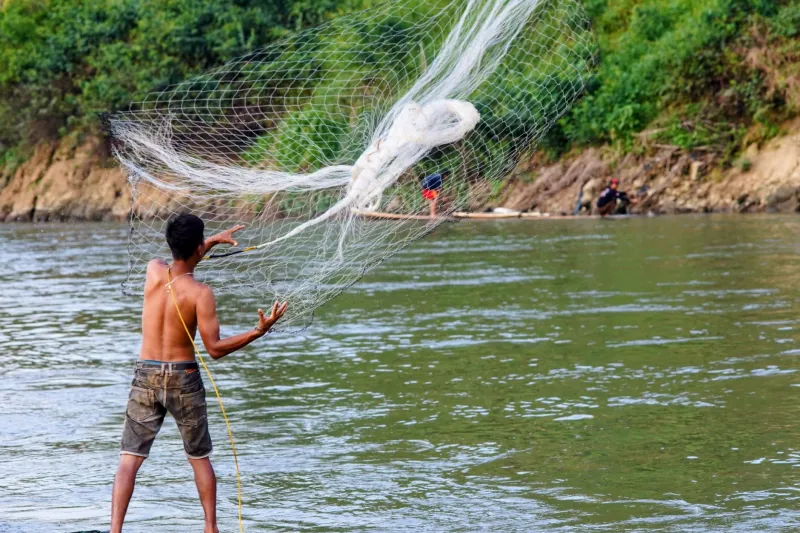
Photo by Photo by Yuval Zukerman on Unsplash on Unsplash
Somewhere along the Klamath River, a tribal elder is watching the water. Not with a sensor array. Not with a satellite uplink. He's watching the way light breaks across a riffle, the color of the current, the behavior of the herons standing downstream like patient gray sentinels. He's doing what his family has done for a very long time — and right now, his forecast for this season's Chinook run is more accurate than the one sitting in a federal database three states away.
That's not a feel-good story. That's a documented pattern that's been quietly unsettling the fisheries science world for years.
The Models Are Struggling — And Everyone Knows It
Climate change has turned salmon forecasting into something close to guesswork. Ocean temperatures are swinging in ways that scramble the neat predictive frameworks built over decades of data collection. The Pacific Decadal Oscillation — a major driver of salmon abundance — has become increasingly erratic. Marine heatwaves like the notorious 2014-2016 "Blob" wiped out entire year classes of fish that models simply didn't anticipate. State and federal agencies have been caught flat-footed, issuing harvest recommendations that turned out to be dangerously optimistic or needlessly conservative.
Meanwhile, tribes like the Yurok, the Lummi, the Nez Perce, and the Quinault have been managing their fisheries through conditions that would have been unrecognizable to their grandparents — and doing it with a kind of adaptive precision that's drawing serious scientific attention.
"The models assume a kind of stationarity that the climate is no longer providing," says one fisheries biologist who has collaborated with tribal resource managers in the Columbia Basin. "But traditional ecological knowledge doesn't assume stationarity. It's built on reading variability. That's a fundamentally different epistemological starting point."
In plain English: Western science built its tools for a stable world. Indigenous knowledge was built for a dynamic one.
Generations as Data Points
Here's what's easy to miss when people talk about traditional ecological knowledge, or TEK: it isn't folklore. It's empirical. It's observational data accumulated across hundreds of generations, tested constantly against reality, and refined by the brutal feedback loop of survival.
The Yurok Tribe on the Klamath has been tracking salmon for longer than the United States has existed. Their fisheries department now integrates that intergenerational knowledge directly into management decisions — and the results have been striking. During the chaotic years following the Klamath's historic dam removals, Yurok monitors were tracking fish movement and spawning behavior in real time, identifying patterns in ways that gave managers a meaningful head start on what the river was actually doing versus what the models predicted it would do.
The Nez Perce Tribe in Idaho operates one of the most sophisticated tribal fisheries programs in the country. Their biologists — many of them tribal members trained in both Western science and traditional practice — run hatchery programs, conduct spawning ground surveys, and pull from oral histories that document how salmon behaved during previous periods of environmental stress. When Snake River spring Chinook returns defied federal predictions in recent years, Nez Perce resource managers had already flagged the anomaly weeks earlier.
"We don't separate the science from the story," one Nez Perce fisheries manager explained at a Pacific Northwest tribal fisheries symposium. "The story is part of the data."
Reading the River's Whole Body
One of the things that makes traditional forecasting so hard to replicate algorithmically is that it's holistic in ways that databases struggle to capture. A tribal monitor watching a salmon stream isn't just counting fish. They're reading the insects, the water temperature, the streamside vegetation, the behavior of bears and eagles, the timing of snowmelt. They're cross-referencing what they see against memories — their own and their community's — of what those same conditions produced in previous years.
The Lummi Nation in Washington State has long maintained what they call a "living relationship" with the Nooksack River system, one that informs everything from harvest decisions to habitat restoration priorities. When tribal elders began reporting unusual changes in the timing of certain salmon runs years before monitoring equipment confirmed the shift, fisheries managers took note. The elders were right. The fish had changed their schedules in response to warming stream temperatures — something the sensors eventually caught up to.
That kind of early detection matters enormously in a world where managers need every possible lead time to make good decisions.
The Science Is Finally Catching Up to the Conversation
For most of the 20th century, the relationship between tribal resource management and federal fisheries science ranged from adversarial to dismissive. Tribes fought for decades just to have their treaty rights recognized, let alone their ecological expertise. The landmark 1974 Boldt Decision in Washington State, which affirmed tribal fishing rights, was a legal turning point — but the deeper shift, the one where Western scientists started genuinely incorporating TEK into their methodologies, has been slower and more uneven.
That's changing. Partly out of necessity, partly out of genuine intellectual humility from a new generation of researchers who grew up understanding that climate change demands every tool available.
The Pacific Coast Collaborative, which coordinates salmon management across state, federal, and tribal jurisdictions, has increasingly structured its processes to give tribal knowledge a formal seat at the table — not as a cultural courtesy, but as a scientific input. NOAA Fisheries has piloted programs in the Pacific Northwest explicitly designed to document and integrate TEK into stock assessment frameworks.
Some academic researchers are going further, publishing peer-reviewed work that treats Indigenous ecological observations as primary data sources on equal footing with instrumented monitoring. It's a methodological shift that would have been rare a decade ago.
What This Means for the Fish — and for All of Us
Salmon are a keystone species in a way that's hard to overstate. They feed orcas. They fertilize forests. They connect the ocean to the mountains in a nutrient cycle that sustains ecosystems hundreds of miles from the coast. When salmon forecasting fails, the consequences ripple outward in every direction.
Getting those forecasts right — especially as climate volatility makes them harder — isn't just a fisheries management problem. It's an ecological survival question for the entire Pacific Northwest watershed.
The tribes have been paying attention to that watershed since long before anyone was running climate models. They've watched it change, adapted to it, and built knowledge systems precisely designed to make sense of its complexity. The fact that Western science is finally recognizing the value of that expertise isn't just good news for salmon. It's a reminder that the most sophisticated tool in conservation isn't always the newest one.
Sometimes it's the oldest one, held carefully across generations, waiting for the rest of the world to ask the right questions.
The river has always known. We're just starting to listen.