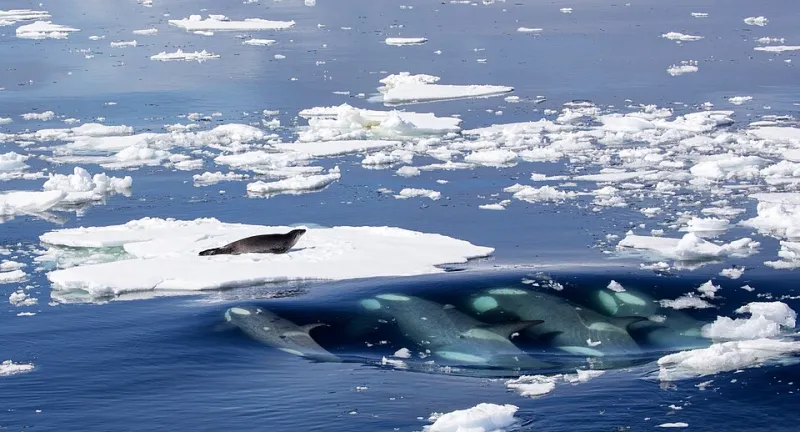
Grandma Knows Best: How Orca Matriarchs Run the Ocean's Most Rigorous School

Photo by Photo by Thomas Chizzali on Unsplash on Unsplash
There's a moment researchers off the coast of Washington State describe again and again — a juvenile orca circling a school of Chinook salmon, hesitating, then watching an older female demonstrate the exact angle of approach with almost theatrical patience. The young whale tries again. Gets it right. The older female nudges alongside briefly, then peels away. Class dismissed, for now.
No chalkboards. No standardized tests. But make no mistake: what's happening inside an orca pod is nothing short of a structured education system, one that has been refined over thousands of years and is, in many ways, more adaptive than anything we've managed to build on land.
The Matriarch at the Center of It All
If you want to understand how orcas learn, you have to start with the oldest female in the pod. She is, functionally, the head of school. Research from the Center for Whale Research and studies published out of the University of Exeter have shown that pods led by older matriarchs — particularly post-reproductive females — demonstrate significantly higher survival rates during periods of low salmon availability. These elder whales aren't just passengers coasting on experience. They're actively guiding their families toward food sources they've visited before, sometimes decades earlier.
This is remarkable for a simple reason: post-reproductive female orcas can live well into their 90s. A matriarch who stopped having calves at 40 might spend the next 50 years doing almost nothing but teaching, navigating, and holding her family together. Evolution, it turns out, built a grandmother.
Scientists call this the "grandmother hypothesis," and while it's been discussed in human evolutionary biology for years, orcas offer one of the most striking non-human examples of it in the animal kingdom. The knowledge these females carry — migration routes, hunting strategies, where the fish run deep in a bad year — is irreplaceable. When a matriarch dies, her pod's survival rate drops noticeably. That's not sentiment. That's data.
The Curriculum: Hunting, Navigation, and Culture
So what exactly are young orcas being taught? The curriculum, if you want to call it that, breaks down into a few key areas.
Hunting technique is the most visible. Different orca populations have developed wildly different methods for taking prey, and none of them are instinctual. Southern Resident orcas in the Pacific Northwest specialize in chasing Chinook salmon in ways that require precise coordination and timing. Bigg's killer whales — the transient population that ranges up and down the West Coast — hunt marine mammals using ambush strategies that look almost choreographed. Young orcas spend years watching, mimicking, and failing before they're any good at it. Adults correct them. Older siblings demonstrate. The whole pod becomes a training ground.
Then there's navigation. Orca pods travel thousands of miles seasonally, and the mental maps they carry are staggeringly detailed. Matriarchs lead their families to specific bays, specific underwater ridges, specific tidal channels — locations tied to prey that appear reliably under certain conditions. A young whale doesn't just follow along. It's actively memorizing, building its own internal atlas one journey at a time.
Perhaps the most fascinating layer is cultural transmission. Orca pods have distinct dialects — specific call patterns that identify them as belonging to a particular family. These aren't random. They're learned, maintained, and passed down. A calf born into a pod will spend its entire life using the same core calls its great-grandmother used. That's culture, by almost any definition of the word, and it's being actively taught every single day.
Learning by Doing — With a Safety Net
One of the things that makes orca education so effective is that it's almost entirely experiential. Young whales don't sit on the sidelines. They're thrown into the action early, with older animals close by to intervene when things go sideways.
Researchers have documented adult orcas deliberately releasing live prey — injured fish, stunned seals — so that juveniles can practice the kill. It's uncomfortable to watch, honestly, but it's extraordinarily effective pedagogy. The young whale gets real feedback in real conditions, with an experienced animal nearby to step in if needed. Compare that to how human children learn to drive — supervised, low-stakes environments before the real thing — and the parallel is hard to ignore.
Siblings play a huge role too. Older calves often serve as what you might call teaching assistants, engaging younger siblings in play behaviors that double as skill rehearsals. Breaching, spy-hopping, tail-slapping — these aren't just fun. They're physical conditioning and coordination training wrapped in what looks like goofing around.
What Changing Oceans Are Doing to the Classroom
Here's where things get sobering. The knowledge matriarchs carry is tied to a specific version of the ocean — one with reliable salmon runs, predictable migration corridors, and stable prey populations. As warming waters push fish populations into new ranges and alter the timing of seasonal runs, some of that hard-won knowledge is becoming less reliable.
For Southern Resident orcas, already listed as endangered under the Endangered Species Act, this creates a compounding problem. Not only are their primary prey — Chinook salmon — declining in number, but the mental maps matriarchs have spent decades building are increasingly leading pods to places where the fish no longer show up on time. The curriculum is still being taught. But the subject matter is shifting faster than the teachers can adapt.
Conservation researchers are watching this closely. Some advocate that protecting matriarchs specifically — not just the population broadly — should be a priority, because losing an elder female doesn't just mean losing one whale. It means losing the living library she carries, and potentially compromising the survival of everyone she was still teaching.
Why This Should Change How We Think About Marine Conservation
The orca classroom forces us to reckon with something conservation policy has been slow to fully absorb: these aren't just animals. They're cultures. And cultures can be lost even when populations technically survive.
A pod that loses its matriarch, or that grows up without access to elders who carry intact ecological knowledge, is a pod that may survive biologically but struggle functionally. It's the marine equivalent of a community losing its elders before their knowledge can be passed on — the kind of loss that doesn't show up in population counts but shows up everywhere else.
The good news is that orcas are extraordinarily resilient learners. Given stable conditions and healthy prey, they adapt. Young animals who grow up watching elders navigate novel challenges internalize flexibility alongside tradition. The question is whether we're going to give them the time and the ocean they need to keep teaching each other.
Out here on the water, watching a grandmother whale circle back to correct a juvenile's approach angle for the third time in an afternoon, it's hard not to feel both awed and a little humbled. We've been running schools for a few thousand years. These animals have been at it a lot longer — and they haven't lost a student yet.